Summary
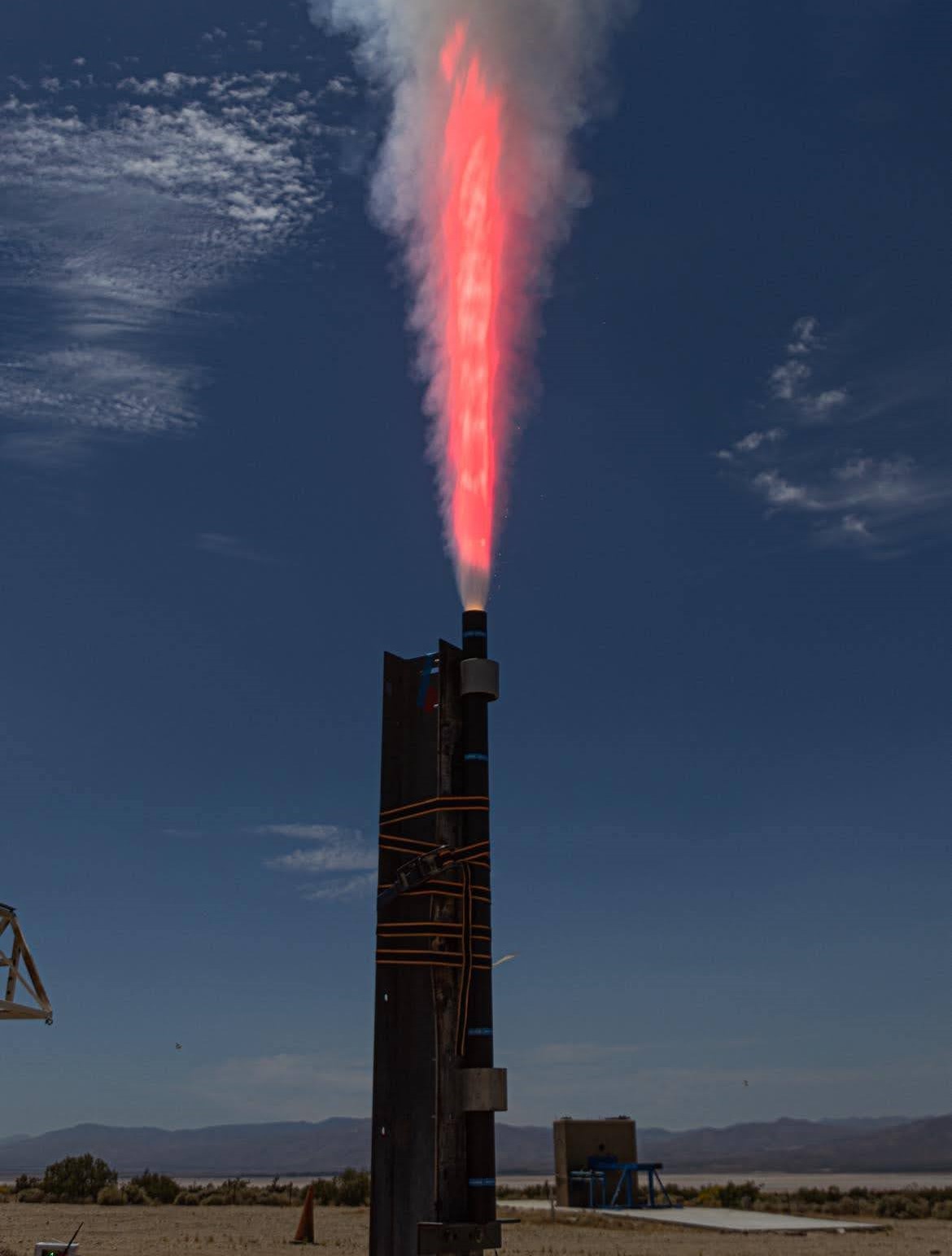
As a personal project with two friends, we designed, manufactured, and successfully tested a carbon composite casing for a solid rocket motor. The casing was made by a hand wet-preg process, using a high temperature resin and twill weave carbon fabric. The ends were retained using smaller carbon tubes, epoxied in place with a structural adhesive after suitable bond preparation. Under hydrostatic testing, the casing and closures withstood an internal pressure 3500psi (240 bar) without failure. The casing was then loaded with the solid rocket motor components and successfully static fired, with a 4 second burn and a maximum internal pressure of 1000-1400 psi.
Background
Amateur solid rocket motors are typically designed such that single-use components such as the propellant, liner, nozzle, etc, are loaded into a reusable aluminium casing, with aluminium closures to retain the components inside. While this allows for a reusable pressure vessel, making the cost of the motors cheaper in the long-run, the cases tend to be relatively heavy due to their material and safety requirements for them to be reusable. The assembled motors are then installed into the airframe of the rocket. However the airframe is typically a composite structure that would, in theory, be capable of holding the pressure of combustion. The excess mass caused by this typical set up is not ideal when developing high preformance rockets, which minimizing the “empty” mass of the rocket is critical. Thus the aim of this project was to develop a carbon composite structure that could act as both the airframe and rocket motor casing, which would significantly reduce the empty mass of the rocket, as well as reduce the diameter, and thus the drag force on the rocket.